
The Question Every Caregiver Eventually Asks
Somewhere around the fourth or fifth daily medication, managing pills from loose bottles stops working. A parent in a Rego Park co-op calls to ask whether she already took the blood pressure tablet this morning. An adult son in another borough finds three weeks of a thyroid prescription untouched. A home aide is not sure whether the evening dose was given before her shift started. At that point most families reach for a plastic pill organizer from the drugstore shelf, and for some people that is enough. For many others it is not, and the better answer is a pharmacy-filled blister pack. This article compares blister packs vs pill organizers honestly, explains where each one fails, and helps you decide which one fits the person you are caring for, whether that is yourself or someone else.
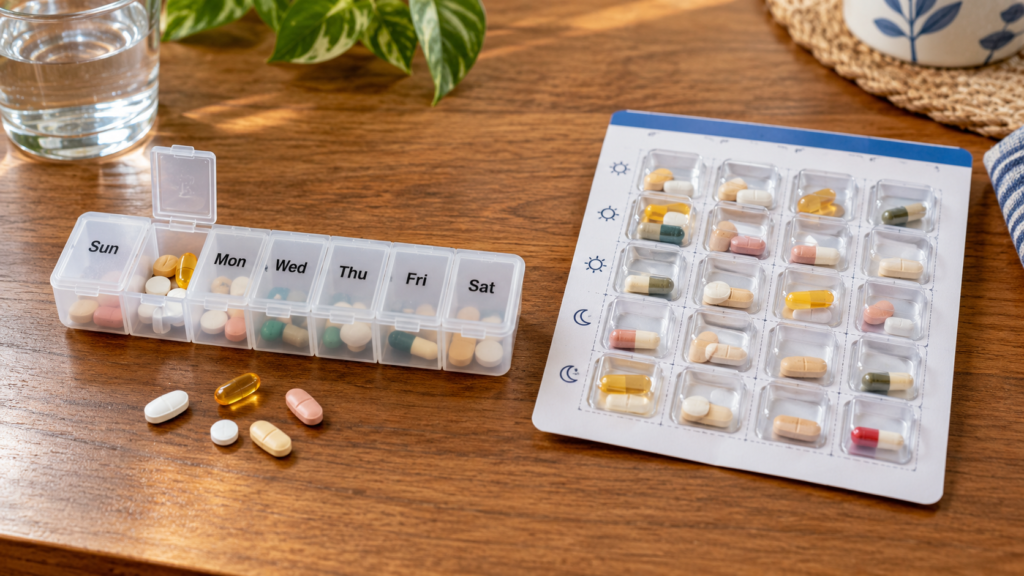
A pill organizer is a reusable plastic box with compartments that you or a caregiver fill by hand, usually once a week. A blister pack is a sealed card prepared by a pharmacy, with every medication sorted into labeled compartments by date and time, so each dose is visibly taken or visibly not. Pill organizers are cheap and flexible but depend on whoever fills them getting it right every week. Blister packs remove the filling step entirely, are checked by a pharmacist, and are the safer choice for anyone on four or more daily medications, anyone with memory concerns, or anyone whose medications are managed by multiple people. MedAid Pharmacy at 98-32 Queens Blvd, Rego Park, NY 11374 prepares blister packs and delivers them free across Queens. Call (718) 516-0000 to ask whether it is the right fit.
What a Pill Organizer Actually Does
A pill organizer is the familiar plastic box with seven or fourteen or twenty-eight lids, sometimes color coded for morning, noon, evening and bedtime. You buy it once for a few dollars, and every week someone sits down with the bottles and fills the compartments.
Where Pill Organizers Work Well
For a person on one to three medications, all taken once a day, with no memory problems and no one else involved in their care, a pill organizer is a reasonable tool. It is cheap, it travels easily, and it gives a simple visual check: if the Tuesday lid is still closed at bedtime, the Tuesday dose was missed. Many people in Forest Hills and Rego Park manage perfectly well this way for years.
Where Pill Organizers Fail
The problems begin at the filling stage, and they are more common than most families realize. Filling a weekly organizer for someone on six medications means handling six bottles and placing twenty to forty tablets into the right slots, by hand, from memory or from a list, usually at the kitchen table. Tablets that look alike get swapped. A dose that is taken twice daily ends up in the morning slot only. A medication the doctor stopped last month is still being loaded because the bottle is still in the cabinet. A new prescription started on Wednesday is forgotten until the following Sunday fill.
Then there is the handling problem. Organizer compartments are not sealed. Pills fall out, get mixed between slots when the box is dropped or tipped in a bag, and can be exposed to humidity in a bathroom cabinet. For someone with arthritis or limited vision, opening the small lids is a daily struggle, and it is easy to open the wrong one.
Finally, organizers make it hard for anyone other than the filler to verify what is in them. A home aide looking at a Thursday compartment sees five tablets. She cannot tell whether that is the right five, or whether one is missing, because nothing on the box says what should be there.
What a Pharmacy Blister Pack Does Differently
A blister pack, sometimes called a multi-dose pack, adherence pack or bubble pack, is prepared at the pharmacy rather than at home. The pharmacy takes all of a patient’s medications, sorts them by date and by time of day, seals each dose into its own compartment on a card, and prints a label showing exactly which medications and strengths are inside each compartment. The card typically covers a week or a month, and a new one arrives before the old one runs out.
Filled and Checked by the Pharmacy
The person filling the pack is a pharmacy professional working from the actual prescription records, not from a list on the refrigerator. When a doctor changes a dose or stops a medication, the pharmacy updates the next pack. The patient and the family do not touch loose pills at all. At MedAid Pharmacy in Rego Park, the blister medication packaging service is built around exactly this: the pharmacy keeps the medication list current, prepares the packs, and delivers them.
Sealed, Labeled and Tamper Evident
Each compartment is sealed. Nothing falls out or migrates between doses. If a compartment is broken open, the dose was taken; if it is intact, the dose was not. That single feature answers the question caregivers ask most often, “did she take it,” without a phone call or a guess. The label on each compartment lists the medications inside, so a home aide, a visiting nurse or a family member can confirm the contents at a glance.
Built for Multiple Caregivers
Many older residents in Queens have care split between a spouse, adult children who live elsewhere, a home attendant and sometimes a visiting nurse. A blister pack gives all of them the same reference. Nobody has to remember what was given; the card shows it.

Side by Side: Blister Packs vs Pill Organizers
Most blister packs vs pill organizers comparisons online are written by companies selling one or the other. This one is written by a pharmacy that uses both, so the trade-offs below are the ones patients and caregivers in Queens actually run into.
Accuracy
Pill organizers are only as accurate as the person filling them that week. Blister packs are prepared from pharmacy records and checked before they leave the pharmacy. For accuracy, blister packs win clearly.
Visibility
Both give a visual cue, but an organizer shows only whether a lid is open. A blister pack shows whether the dose was taken and what the dose contained. Blister packs win.
Handling Changes
When a prescription changes, an organizer has to be emptied and refilled by hand, and the old bottle has to be removed from circulation. A blister pack is simply updated by the pharmacy on the next cycle. Blister packs win, with the caveat that a mid-cycle change may require a replacement card.
Cost
A pill organizer costs a few dollars once. Blister packaging is a pharmacy service. Whether there is a charge, and how much, depends on the pharmacy, the number of medications and insurance. Ask the pharmacy directly. On cost alone, organizers win, though a single hospital visit caused by a medication error costs more than years of packaging.
Portability
A weekly organizer fits in a purse. A blister card is flat but larger. For travel, most pharmacies can prepare a shorter card covering the trip. Roughly even.
Independence
Some people feel that a blister pack takes control away from them. Others feel the opposite: it lets them stay in their own apartment longer because the family stops worrying. This is personal, and it is worth talking through.
Who Should Switch to Blister Packs
When families ask the pharmacist about blister packs vs pill organizers, the answer usually depends on which of the following describes the patient. Blister packs are the safer choice in a few clear situations.
Anyone taking four or more medications a day, especially when some are taken more than once daily. The combination count is where hand-filling errors multiply.
Anyone with early memory loss, confusion or a recent hospital discharge with changed medications. The MedlinePlus guide to keeping your medicines organized notes that keeping an accurate medicine record is one of the most important safety steps, and a pharmacy-prepared pack is that record made physical.
Anyone whose medications are given by more than one person, including home attendants and rotating family members.
Anyone recovering from an injury who has new short-term medications layered on top of existing ones. Pain management after a car accident or a workplace injury is a common example, and patients using the pharmacy’s workers compensation and no-fault pharmacy service often add blister packaging for exactly this reason.
Anyone who has already had a medication mix-up, a double dose or a missed course. One incident is reason enough.
Who Can Keep Using a Pill Organizer
A pill organizer remains a fine choice for a person on a small number of once-daily medications, with good memory and eyesight, who fills it themselves and has no one else involved. If that describes you or your parent, there is no need to change. Keep a written medication list in the same place as the organizer, and review it with a pharmacist a couple of times a year. The pharmacy offers private pharmacy consultations for that kind of review, in person or by phone.

How Blister Packaging Works at MedAid Pharmacy
Starting is simpler than most families expect.
Step One: Move the Prescriptions to One Pharmacy
Blister packaging only works if the pharmacy preparing the pack has every prescription. If medications are spread across two or three pharmacies, which is common after a hospital stay, the first step is consolidating them. The prescription refill and transfer process handles this with one call: give the staff the names of the other pharmacies and the medications, and they do the rest.
Step Two: Review the Full List With the Pharmacist
Before the first pack is prepared, the pharmacist reviews the complete medication list with the patient or caregiver, confirms doses and timing with the prescribers where needed, and flags duplicates or interactions. This review alone catches problems that have been sitting unnoticed for months.
Step Three: Receive the Pack, Then Keep Receiving It
The first pack is prepared and either picked up at 98-32 Queens Blvd or delivered. Delivery is free across Queens, with no minimum, and packs can be set to arrive on a regular schedule so the household never runs out. Over-the-counter items and specialty vitamins and products that the patient takes regularly can be included in the delivery, though vitamins are usually kept separate from the sealed prescription compartments unless the prescriber asks otherwise.
What About Specialty or Unusual Medications
Some medications, such as certain specialty medications with special storage needs, liquids, inhalers, injectables or items that must stay in original packaging, cannot go into a blister card. The pharmacy packs everything that can be packed and supplies the rest alongside it with clear instructions.
Common Mistakes Even With Blister Packs
Blister packs reduce errors but do not eliminate the need for attention.
The most common mistake is keeping old loose bottles in the cabinet after switching. Family members or aides see a bottle and give a dose on top of the pack. When you switch, remove the loose bottles or hand them to the pharmacy for disposal.
The second is not telling the pharmacy about a change. If a doctor stops a medication at an appointment, the pharmacy needs to know before the next pack is prepared. Most offices send changes electronically, but a quick call confirms it.
The third is pushing a dose out of the wrong compartment. Clear date and time labels and a consistent routine, such as taking the morning dose with breakfast at the kitchen table rather than on the way out the door, prevent most of this.
A Note for Families Managing Care From a Distance
A large share of the blister packaging requests at this pharmacy come not from the patient but from a son or daughter in Brooklyn, Long Island or out of state who is trying to manage a parent’s medications in Rego Park, Forest Hills or Elmhurst from afar. If that is you, the practical setup is this: consolidate the prescriptions here, authorize the pharmacy to speak with you about the medications, set up recurring delivery, and ask the pharmacy to call you when a prescriber changes something. The aide or the parent then handles the pack day to day, and you have a single number to call with questions. Residents on the Forest Hills side can read the pharmacy near Forest Hills page for delivery details; everyone else in the borough is covered from the pharmacy in Rego Park.
Making the Decision
If you are weighing blister packs vs pill organizers, the honest summary is this. Pill organizers are fine for simple regimens managed by one capable person. Blister packs are safer for everyone else, and especially for the four-plus medication, multiple-caregiver, memory-concern situations that describe a great many households in central Queens. The cost difference is small next to the cost of a single error. And the setup takes one phone call.
Talk to the Pharmacist
MedAid Pharmacy is at 98-32 Queens Blvd, Rego Park, NY 11374, open Monday through Thursday 9 am to 7 pm, Friday 9 am to 5 pm and Sunday 10 am to 5 pm. Call (718) 516-0000 to ask about blister packaging, transfer prescriptions from another pharmacy, or set up a medication review for yourself or a parent. Refills and transfers can also be requested at medaidrx.com, and directions and reviews are on the pharmacy’s Google Business Profile.
Frequently Asked Questions
A pill organizer is a reusable plastic box that you fill by hand each week from loose bottles. A blister pack is a sealed, labeled card prepared by a pharmacy with each dose sorted by date and time. The key difference is who fills it and whether it is checked: organizers depend on the person filling them, while blister packs are prepared from pharmacy records and verified before they leave the pharmacy.
For most seniors on four or more daily medications, yes. Blister packs remove the hand-filling step where most errors happen, seal each dose so nothing falls out or gets mixed, and label each compartment so any caregiver can verify the contents. A pill organizer can still be appropriate for someone on a few once-daily medications who fills it themselves.
Most oral tablets and capsules can be packed together by date and time. Liquids, inhalers, injectables, some specialty medications and items that must stay in original packaging cannot be blister packed, and the pharmacy supplies those separately with instructions.
Call (718) 516-0000. The pharmacy transfers all of your prescriptions from any other pharmacies, reviews the full medication list with you or your caregiver, prepares the first pack, and sets up pickup or free delivery on a recurring schedule.
It depends on the pharmacy, the number of medications and your insurance. Ask the pharmacy directly for your situation before starting. There is no charge for delivery of the packs within the pharmacy’s delivery area.
Tell the pharmacy, or have the doctor’s office send the change electronically. The next pack is prepared with the updated list. If the change is urgent, the pharmacy can prepare a replacement card for the remainder of the current cycle.
Yes, and that is one of the main advantages. Each compartment is labeled with the medications inside, so a home attendant, visiting nurse or relative can confirm what was taken and what is due without calling anyone.


